Mallet Foundations I · Lesson 1
Meet the keyboard family
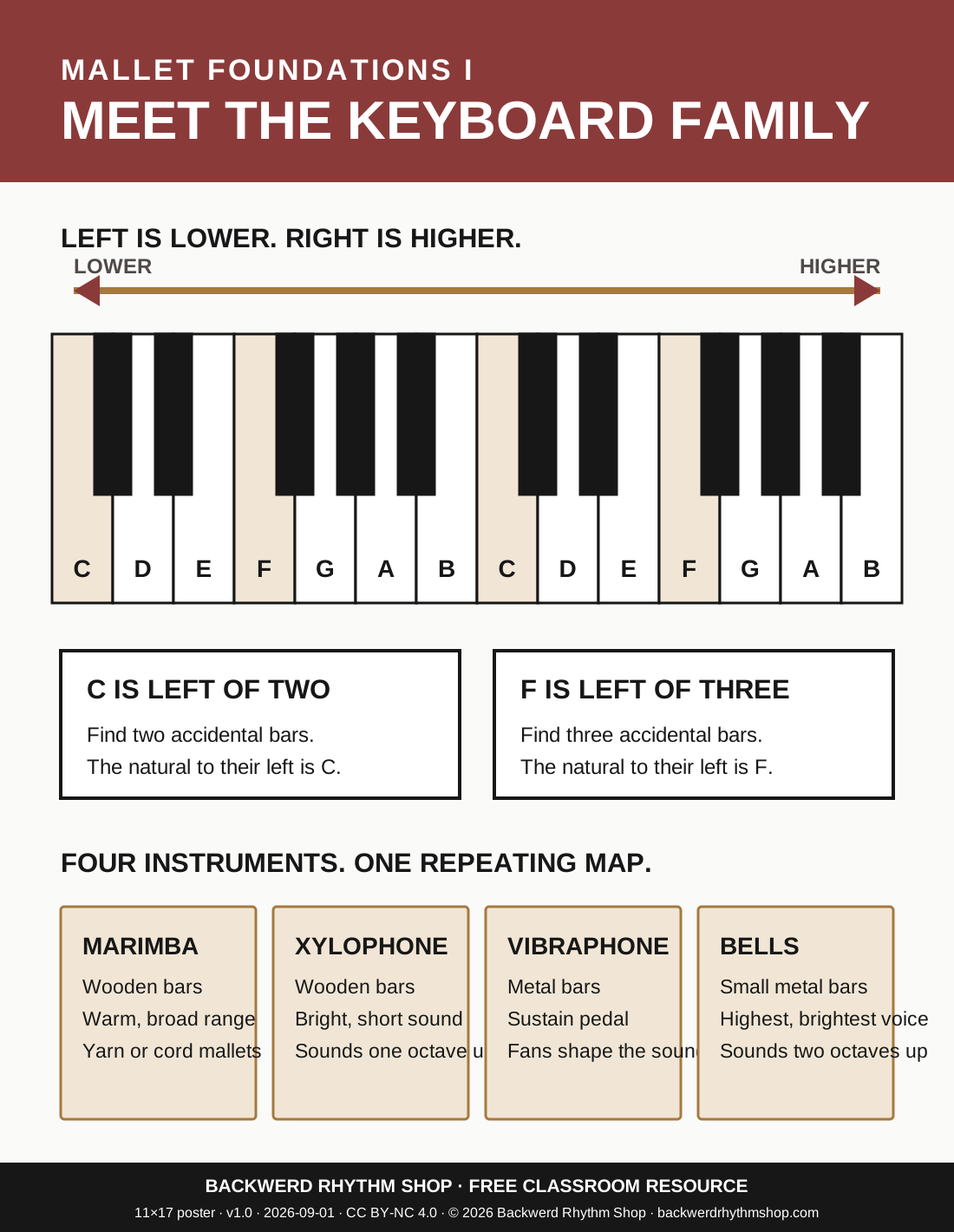
Marimba, xylophone, vibraphone and bells look different and sound different. Under your hands, they share the same repeating map.
Four relatives, four voices
- Marimba
- Wooden bars, resonators and the broadest warm register in the family. Softer yarn or cord mallets are common.
- Xylophone
- Wooden bars with a shorter, brighter sound. Its written notes sound one octave higher.
- Vibraphone
- Metal bars, a sustain pedal and rotating fans. Its sound can ring after the mallet leaves the bar.
- Bells
- Small metal bars with the highest, brightest voice. Their written notes sound two octaves higher.
Same map, different range
Not every instrument begins and ends on the same note. The repeating order of the bars stays the same; each instrument shows a different-sized window into it.
Left is lower. Right is higher.
Stand at the player side of the instrument. Move left and the bars grow larger while the pitch moves lower. Move right and the bars grow smaller while the pitch moves higher.
“High” and “low” describe pitch, not where a bar sits vertically in the frame. An accidental bar may be physically farther away from you while sounding only one half step above the natural bar beside it.
Two rows, one keyboard
The long front-row bars are naturals. The shorter raised bars are accidentals. Some teachers call the two rows the lower and upper manuals.
Do not count every bar from the bottom
Use the two-and-three pattern as a landmark. It works on every keyboard percussion instrument, even when the instrument begins on a different note.
C is left of two. F is left of three.
Find a group of two accidental bars. The natural bar immediately to its left is C. Find a group of three. The natural bar immediately to its left is F.
- Find a group of two accidentals.
- Move to the natural bar immediately left of the group. That is C.
- Find a group of three accidentals.
- Move to the natural bar immediately left of the group. That is F.
After B, the map starts again
The natural letter names run A B C D E F G. After G they repeat. From one C to the next C is an octave: the note name returns at a higher or lower register.
Once you can find C and F, every other natural is only a few steps away. That is the geography the next lessons will use for reading.
Try the keyboard scavenger hunt
Point or gently touch; do not score mallet technique yet.
- Find the lowest and highest bars available.
- Find three different Cs and three different Fs.
- Find two bars with the same letter name.
- Move one octave higher from a note your teacher chooses.
- Explain whether a second note is higher or lower than the first.
The same topic, every way you need it
Hang it, read it, print it, drill it.
Every Backwerd topic identifies the faces that are ready — poster, lesson, printable sheet, app drill, board and teacher plans — and names an honest gap when one is not. The available faces share one set of conventions, so what hangs in the room never disagrees with what gets taught.
-
Wall
Meet the Keyboard Family
The same topic at wall-reading size — 11 × 17, black-and-white safe, free.
Download the poster -
Screen
Meet the Keyboard Family
Marimba, xylophone, vibraphone and bells: four voices, one repeating keyboard map, and the C and F landmarks that make every note findable.
You are here.
-
Desk
Printable worksheet and answer key
A student sheet and its matching key, generated together so they cannot disagree.
Print the worksheet -
Drill
Practice this in an app
No current app sequence isolates instrument-family recognition and keyboard geography at this level.
Not available yet.
-
Board
Mallet Board
Project the two-octave keyboard while students identify high and low direction, the two-and-three accidental pattern, C and F landmarks, and octave repetition.
Open Mallet Board -
First teach
A 45-minute class
Students can distinguish the four keyboard-percussion voices, describe high and low direction from the player side, and locate C and F from the repeating two-and-three accidental pattern.
Open the lesson plan -
Review
A 20-minute review
Students can repair one common keyboard-geography error by using high-low direction and the two-and-three accidental pattern to find C, F and a matching octave.
Open the review plan